GUIDE 05 / Gear / Technique
Sony Alpha 7 V: A Hybrid Camera Built for Shooters Who Refuse to Pick One Lane
A practical look at the Sony Alpha 7 V for photographers and videographers, including its 33MP partially stacked sensor, AI autofocus, 30 fps bursts, stabilization, and place in a real hybrid workflow.
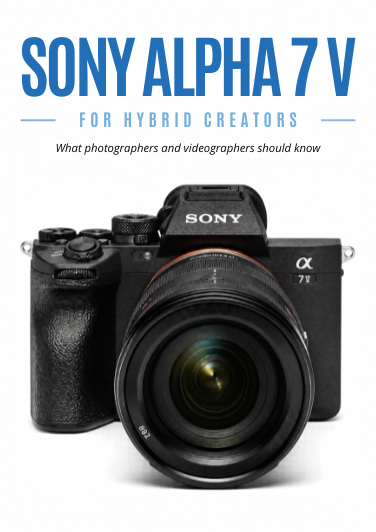
Photography and video used to feel like two different jobs with two different bags. That line keeps getting thinner.
For working creators, the real question is no longer whether a camera can shoot both. Almost every modern mirrorless body can. The better question is whether it can move between stills and motion quickly enough that the camera disappears and the work takes over.
That is what makes the Sony Alpha 7 V interesting. Sony's current product materials list a 33-megapixel full-frame partially stacked Exmor RS CMOS sensor, the BIONZ XR2 processor with an integrated AI processing unit, blackout-free continuous shooting up to 30 frames per second with full AF/AE tracking, and up to 7.5 stops of central image stabilization. What do those numbers change when you are photographing a concert, directing a lifestyle portrait, covering an event, or switching into video without rebuilding your entire setup? That is the part worth talking about.
1. The 33MP sweet spot makes more sense than chasing resolution
Resolution is useful until it starts taxing everything else in the workflow.
A 33MP full-frame file gives photographers meaningful room to crop, straighten, reframe for social formats, and deliver large client images without automatically creating the storage and processing burden associated with much higher-resolution bodies.
For portraits and lifestyle work, that extra crop room matters. You can photograph a wider environmental frame and still pull a tighter composition later when the final image needs to live in a vertical social post, website banner, or campaign crop.
For events and concerts, moderate resolution can be even more practical. Hundreds or thousands of frames add up quickly. A balanced file size helps keep culling, transferring, backing up, and editing from becoming the hidden second shift after the shoot.
TECHNIQUE: Compose for the final image, but leave intentional safety space when a client may need multiple aspect ratios. Resolution should support better delivery—not replace good framing.
2. A partially stacked sensor is about speed, not just specs
The Alpha 7 V's partially stacked sensor architecture is meaningful for hybrid shooters because faster sensor readout can improve the camera's behavior when the scene refuses to slow down.
Sony rates the camera for blackout-free bursts up to 30 fps with AF/AE tracking. Nobody needs 30 frames every second for every assignment. Overshooting can create a brutal culling problem. But access to that speed matters for specific moments: an artist jumping during a live set, confetti firing, a dancer hitting a transition, a champagne pop, or a subject moving through a directed editorial sequence.
The smarter approach is selective speed. Use the fastest burst modes for moments where timing is genuinely unpredictable, then return to controlled shooting when the scene allows it.
3. AI autofocus matters most when it gives your attention back
Autofocus marketing can turn into alphabet soup quickly. The practical benefit is simpler: a reliable tracking system lets the photographer spend more mental energy on expression, composition, background, timing, and light.
Sony says the Alpha 7 V uses advanced AI processing for subject recognition across a wide variety of subjects and provides up to 759 phase-detection autofocus points for stills and movies.
That can be useful during portrait sessions with movement. Instead of freezing a client into ten nearly identical poses because you are afraid of losing focus, direct them through actions: walk toward camera, turn through the shoulder, adjust a jacket, laugh away from lens, reset, then reconnect with camera.
POSE: Give subjects verbs instead of statues. Walk, turn, adjust, lean, and look back usually create more believable photographs than asking someone to hold an unfamiliar pose for twenty seconds.
The technology should support that direction—not become the direction.
4. Stabilization expands what handheld can look like
Sony rates the Alpha 7 V for up to 7.5 stops of stabilization at the center of the frame and up to 6.5 stops toward the periphery under its test conditions.
For photographers, stabilization can help when working with slower shutter speeds in available light, although subject movement still has to be considered. A stabilized camera cannot freeze a person who is moving too quickly for the selected shutter speed.
For videographers, stabilization can make quick handheld inserts, detail shots, and lightweight run-and-gun coverage more usable when a tripod or larger rig would slow production down.
That does not mean every shot should be handheld. It means handheld becomes a more deliberate creative option.
Approved Canva editorial cover for the Sony Alpha 7 V hybrid creator feature.
5. The best hybrid workflow is built before the shoot
A capable hybrid body only saves time if the camera is configured to save time.
Before a mixed photo and video assignment, build separate still and movie settings around the job. Confirm autofocus behavior, frame rate, shutter settings, white balance strategy, media capacity, audio settings, and stabilization before the client or artist steps in front of the lens.
A useful event workflow might look like this:
- Stills mode: responsive continuous autofocus, a practical burst setting, RAW capture, and a shutter-speed floor appropriate for subject movement.
- Video mode: chosen frame rate and shutter behavior, consistent white balance, a tested picture profile or color workflow, audio levels confirmed, and stabilization selected intentionally.
- Custom controls: map the settings you actually change under pressure instead of accepting the default button layout.
The goal is not to memorize more menus. It is to touch fewer menus while working.
6. Lens choice still changes the image more than the body
A new camera can improve hit rate and workflow, but lenses continue to define perspective, depth, working distance, and a huge part of the visual signature.
Sony's FE 50–150mm F2 GM is an interesting example of where the E-mount system is heading. Sony describes it as a constant-F2 50–150mm telephoto zoom weighing about 1,340 grams without the tripod base, with four XD linear motors and minimal focus breathing designed to benefit both stills and video.
For portraits, events, and stage work, that range can combine telephoto compression with an unusually bright constant aperture. It is also listed at $3,999.99 on Sony's U.S. store at the time of publication, so it belongs in the category of professional tool rather than automatic upgrade.
GEAR: Buy for the assignments you actually shoot. A lens that earns its place on paid work is more valuable than a technically spectacular lens that stays home because it is too specialized, too heavy, or unnecessary for your style.
7. Who is the Alpha 7 V actually for?
The Alpha 7 V makes the strongest case for creators whose assignments regularly cross boundaries.
Think photographers who also deliver social clips. Event shooters moving between portraits, candids, performances, and recap video. Lifestyle creators producing both campaign stills and motion. Small production teams where one camera may need to cover several roles during the same day.
A dedicated high-resolution studio photographer may prioritize something different. A cinema-first operator may want a body designed more specifically around motion production. And a photographer whose existing camera already meets every client need should not upgrade just because a newer model exists.
New gear should solve a real limitation. That is the test.
8. Lighting is where hybrid shooters need to think differently
Flash can give still photographers tremendous control, but the flash burst does not become continuous illumination when you switch to video.
If a session needs both polished stills and motion, plan the lighting crossover before the shoot. One approach is to shape the environment with continuous fixtures that can work for both formats, then introduce flash when the still photographs need additional punch or a different character.
Another approach is to design two intentional lighting looks: one optimized for photographs and one optimized for video. The key is making the transition fast enough that the subject does not lose momentum.
LIGHTING: Keep modifier placement and direction visually related between the still and motion setups when the final assets need to feel like one campaign. Matching mood matters more than forcing identical exposure tools. For a focused portrait example, see the one-light portrait lighting guide.
9. The bigger shift: cameras are becoming less of a bottleneck
Modern hybrid cameras are increasingly good at removing technical friction. Faster readout, better recognition autofocus, stronger stabilization, and flexible lens ecosystems mean more shots are technically possible than ever. That raises the creative standard rather than lowering it.
If the camera can track the eye, the photographer has more responsibility to notice the background. If stabilization can smooth the shot, the videographer has more responsibility to make the movement meaningful. If burst speed can capture thirty frames in a second, the creator still has to recognize which fraction of that second tells the story.
The machine can help secure the frame. It cannot decide why the frame matters.
Final take
The Sony Alpha 7 V looks compelling because its improvements point toward a practical reality: more photographers are becoming hybrid creators, and more clients expect stills and motion to coexist.
Its 33MP partially stacked sensor, AI-assisted subject recognition, high-speed blackout-free shooting, and improved stabilization are not reasons by themselves to replace a camera that already works. They are tools that can make a demanding mixed-media workflow easier when those capabilities solve problems you encounter on real assignments.
At Flicks by Ed Media, the gear conversation always comes back to the image. Cameras matter. Lenses matter. Lighting matters. But direction, timing, point of view, and knowing what the final piece needs to feel like matter more. You bring the vision. I'll create the moment.
Sony specifications and lens pricing were checked September 23, 2026 against the Alpha 7 V product information and FE 50–150mm F2 GM product page.
Ready to plan your next hybrid shoot?
Then check availability for photography, video, creator content, or a hybrid production with Flicks by Ed Media.